
the shadow channel
On their new album, Spellcaster summons the spellchestra, finding community and joy in resistance.


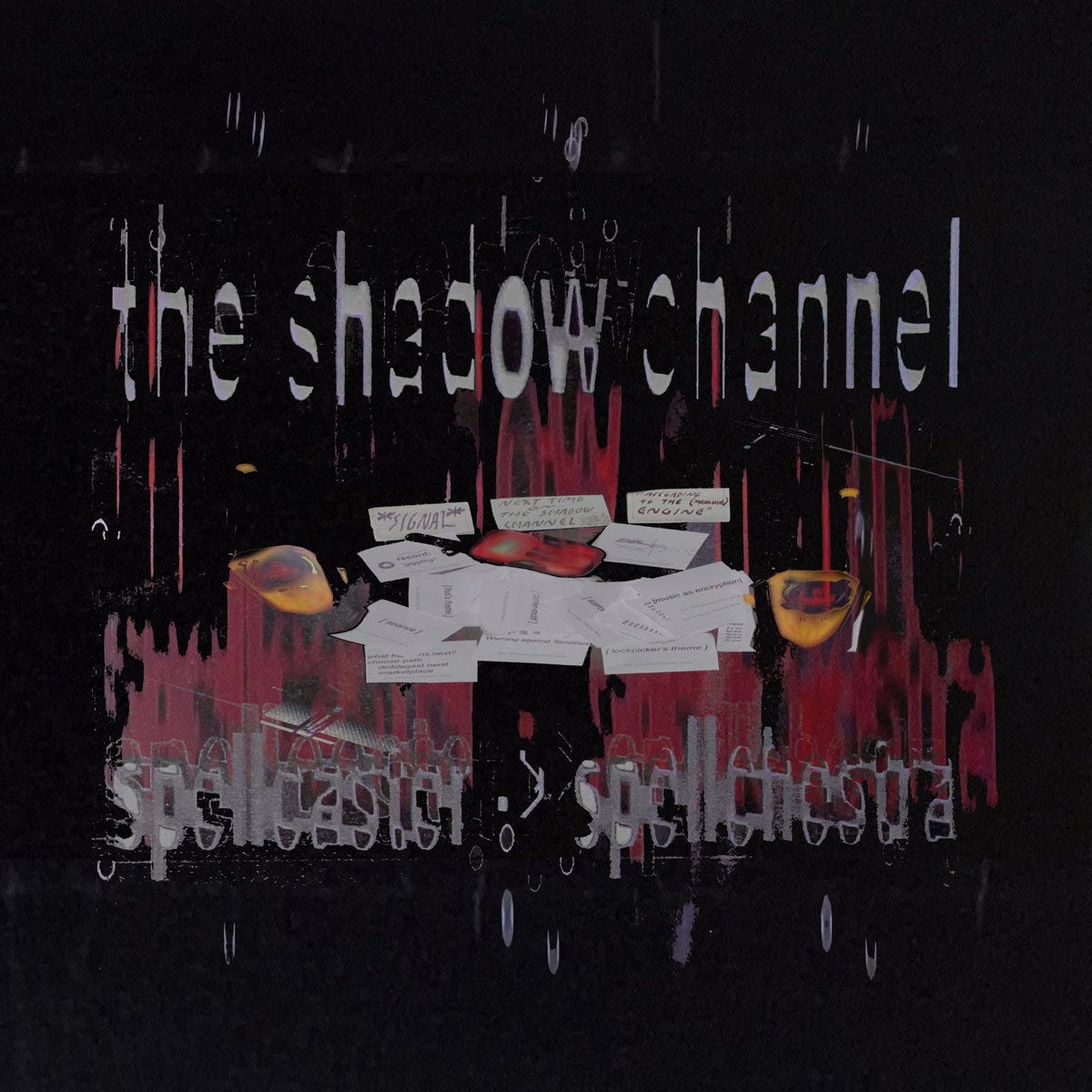
Spellcaster is a wonderfully intricate multimedia project by h hartvig nielsen, a composer, musician, vocalist, and producer who has been an integral part of the Danish experimental music scene for over a decade. From folk-inspired orchestras and ensembles, such as Boli Group and Brynje, to alt-rock-leaning projects, like Lol Beslutning and the notable band Synd Og Skam, their artistic journey has been adventurous and diverse, influenced in equal parts by pop culture, alternative genres, and classical music. Their collaborative, gleeful approach to world-building has, in recent years, found its focus in a trilogy of releases under the Spellcaster moniker that combine elements of fantasy RPGs, video-game logic, and storytelling with abstract instrumentals and quirky electronics.
As the description suggests, Spellcaster is more than an experimental project — it is an interdisciplinary exploration of an ever-evolving storyworld that reassembles itself with every sonic, social, or conceptual intervention. In an interview with Passive/Aggressive Conversations, h hartvig nielsen explains that the fantasy elements in the Spellcaster universe primarily function as an aesthetic that facilitates storytelling through game mechanics. Central to the narrative is anybard, portrayed by hartvig themself, who is both the main character and a vessel for various linguistic, vocal, and philosophical investigations.
We first encountered anybard on Spellcaster’s 2019 debut album, Inventory. The album drifted between a defamiliarized version of alternative pop, obscured folk melodies, and medieval chants that melted and morphed with soft textures and beats. In a sense, Inventory presented an examination and (co-)creation of the self through vocal variations, poetic fragments, and communion with nature. At times reminiscent of a diary and at others a message conveyed to others through self-expression, the album gently introduced topics and questions of memory, communication, empowerment, and interpersonal care that h hartvig nielsen would continue to explore in subsequent releases.
The interplay of dichotomies – nature and technology, self and community, magic and politics – is reflected in the sound itself, unmasking the idea of opposites as arbitrary. All of this served as the perfect foundation for Spellcaster’s sophomore album, memo, where the idea of genres was challenged even further in pretty unique ways. While Inventory provided a glimpse into anybard’s rich inner world, memo unearthed details of their story and developed a more obvious narrative arc. From the opening influx of fragmented melodies, memo set the stage for a more club-oriented aesthetic. Against a euphoric backdrop, anybard tries to situate themselves in reality after waking up with memory loss. As they travel to a place called Stem, they decide to create a musical to restore their memory.
Described as a musical within an opera, the release further explored multimodality by uncovering semantic layers through a recording. anybard records a message for a person named Deleted in an attempt to (re)connect and retrace their steps, and – as they explained in the previously mentioned P/A conversation – the process of reconstructing a memory becomes the very act of creating it. Many questions remain unanswered, but some clarity is gained through the gentle guidance of a character portrayed by dancer, choreographer, and visual artist Lydia Östberg Diakité. Companion hears anybard’s message while it is being recorded and points out the correlation between losing a connection with oneself and losing one’s companions. Thus, the trope of memory loss can be viewed as a metaphor for feelings of isolation in a capitalist society, a theme more clearly explored on Spellcaster’s latest album, the shadow channel.
Released via the Danish label 15 Love, the shadow channel picks up where memo left off: a message was transmitted into the ether in the hope of finding other entities and companions with whom to form the spellchestra. The idea for a more collaborative release stems from a 2023 performance written for “eight walkie-talkies, vocals, and electronic montages based on generative composition engines and bardic methods,” which functions as a sonic and contextual bridge, or intermezzo, between memo and the shadow channel. The communication process is further defamiliarized through a series of interferences in the space between transmission and reception as anybard tries to invoke the entities. It’s no surprise, then, that the shadow channel is Spellcaster’s most experimental album to date.
Consisting of notable artists from the Copenhagen scene, spellchestra includes Oliver Laumann, who has contributed to Spellcaster’s previous releases, Arte Carlader, Mija Milović and Simin Stine Ramezanali from the doom rock trio Slim0, Tettix Hexer, and Stine Victoria Hyun. Lydia Östberg Diakité returns as Companion, and Francesca Burattelli takes on the interesting role of radio host. Each collaborator is a musician, performer, game master, magician, character, and hacker-bard.
The album unfolds like a radio montage, a steady stream of shooms, strings, rough textures, and sharp interferences layered with snippets of doleful piano melodies, indiscernible dialogue, and haunting club quotations. With each listen, new effects and hidden details emerge, emphasizing the expansive richness of the soundscape. The moody ambient noise pieces are occasionally interrupted by choruses that provide clearer narrative contexts; these are the most “song-like” tracks on the album.
The disorienting, dreamlike atmospheres that loom over the album reflect the synthesis of themes examined throughout the whole trilogy. spellchestra slowly assembles over the course of 14 tracks, culminating in a disruptive ritual. In order to neutralize the virus Terminus, described as the feudalizer, they must create fertilizer for a Subversive Tree by using jokes and laughter to challenge the absurdity of the established system.
Feelings of confusion and even frustration arise as the listener tries to decipher the sonic and contextual clues scattered throughout the shadow channel – mimicking the affective chaos of everyday existence: how we relate to ourselves and others, how we bond, speak, laugh, and resist. The open-ended resolution arrives in the final track, “giggl [heist theme].” As the entities assemble, their voices become clear and harmonize with each other against a folk guitar melody. The tension slowly dissipates into heartwarming silliness. With its imaginative and unusual composition, the shadow channel can be interpreted as the characters’ gentle metamorphosis through community care and connection, establishing the correlation between resistance and joy.
 | A guest post by
|