
Solids for Voices
On Valby Vokalgruppe's new album, voice is all they need.


Voices are a fascinating thing. They are mundane and omnipresent, even irksome, to the point where each individual will, at least once in their lifetime, wish to silence them all. Yet, simultaneously, they are almost preternatural extensions of our minds and bodies, serving as essential communication tools, flexible musical instruments, and thrilling vessels of expression. Philosophically, the voice piqued the interest of thinkers such as the French philosopher Jacques Derrida and psychoanalyst Jacques Lacan in the 1960s. Musically, the voice has been an object of obsession for much longer, dating back to some of the earliest traces of composed Western art, such as the Epitaph of Seikilos (c. 1st–2nd century AD).
Anja Jacobsen’s exploration of the voice through the Valby Vokalgruppe collective exists on a ridge between these threads of thought, equally interested in the voice’s phenomenological and sonic qualities. As the Danish composer and bandleader explained to The Wire in 2014, in a discussion about one of her other projects, Selvhenter, the goal is to make vocals “emotionless, almost robotic,” rejecting “assumptions about the voice as some authentic, emotional expression” and letting the instruments “stand in for the feeling.”
Formed in 2008, Valby Vokalgruppe emerged from a series of sessions with eight vocalists who met regularly at Christianshavns Beboerhus in Copenhagen to participate in collective experiments. While the group has remained active since then, contributing music to theatrical plays, performances, and lectures, their recorded work began and ended with the 2012 album Bah New Era, a thrilling compendium of vocal miniatures that, despite their abstract nature, felt breezy and poppy.
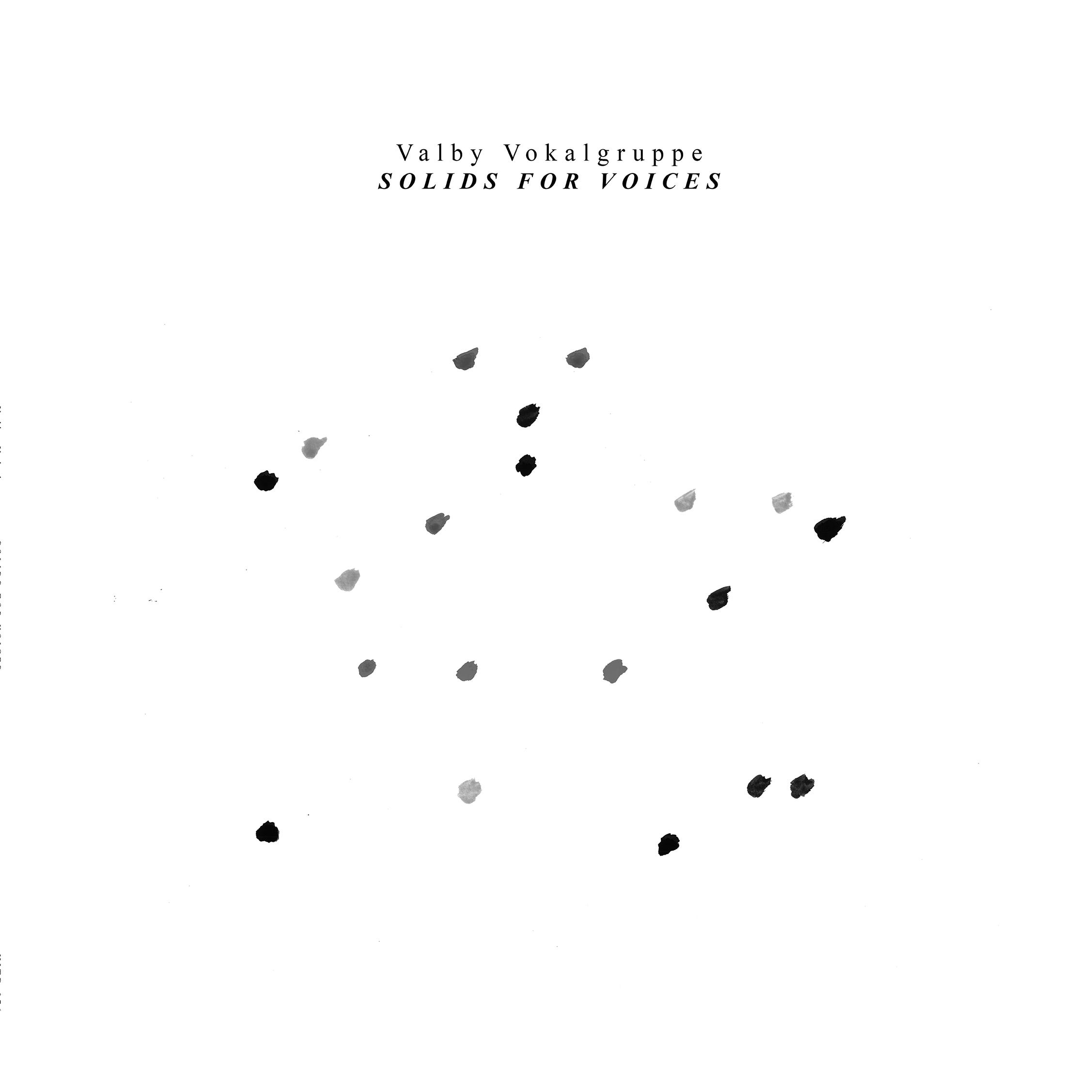
Solids for Voice feels like an evolutionary step, more closely related to the group’s debut and early experiments than to their incidental works. In a sense, it is a return to “music centered around rhythms and voices — transcending into another state.” The solids in the album’s name refer to three-dimensional figures — convex, regular polyhedra, to be exact — known as Platonic solids. Like the sparse, monochrome dots on the album cover’s white background, the title suggests an arrangement of vocal fragments ruled by graphical notation and abstract patterns rather than conventional scores.
In the short intro, “Icosahedral,” we hear an ensemble of voices articulating splintered yet fluent phrases. Joined by Copenhagen-based vocalists and musicians Cæcilie Trier, Sonja LaBianca, and Lil Lacy, Jacobsen brings to life a carousel of “ahs” and “uhs,” tracing rhythmic arrangements in the air. Meanwhile, “Dodecahedral” introduces the plinking electronics of Anders Lauge Meldgaard’s Ondes Martenot–inspired instrument, the New Ondomo, which provides a firmer background for vaguely soulful, almost beat-like vocal segments.
As an instrument in contemporary music, the voice is often explored through subversion and the extreme possibilities of expression, where the limits of extended techniques and vocalizations are investigated by artists such as Phil Minton, Lauren Newton, Isabelle Duthoit, and Audrey Chen. In the music of Valby Vokalgruppe, however, voices have a singsong quality. Whether enunciating full melodies or just their granules, the voices betray a closer relationship to pop than to free improv, bringing to mind the more outré works of Laurie Anderson.
“Monastère de Ségriès” and “19-Fold Axis” are both cases in point. The firm, evenly spaced appearance and disappearance of muted drones and clearly enunciated utterances — hummed consonants, “oohs,” and “ne ne nes” — crystallize into bopping, near-club-ready structures. Even “Delfisk Hymne,” a piece shaped around hymns older than the Seikilos Epitaph (dated 138 and 128 BC), is rendered as a gentle flow reminiscent of chamber pop. Meanwhile, “Prime Solid” sets a thick forest of vibrating electronic textures for the group’s voices and Mette Hommel’s flute to dance within. Here, the atmosphere is one of folk horror and desolation, with jazzy bass frequencies and technoid humming pressed against contrapunto singing.
While the group, as mentioned, does not venture into extended techniques, there is still an intriguing quality to their inflection and relationship with deconstructed language: a sense of tasting syllables and words, as Lyra Pramuk does on her album Hymnal (“Point of Departure”), or shaping them around letters like an electronic formant filter (“M (Spejling)”, “O”).
As the album nears its end, the phrases grow longer, anchored by subtle percussive hits, and increasingly aware of each other. A circling cluster of “hais” haunts “Twelve Pentagons,” and a call-and-response lands in gentle ambience on “Octahedral.” This all culminates in the shimmering textures below and soaring voices above in “Skull Piece,” where the instrumental sections become bolder, the vocals thicker, and the vocalized melodies more intricate, as if asking whether the voice can transform into something else, something more.
In one of Plutarch’s famous anecdotes, a man plucks a nightingale for food but, finding little meat, laments, “You are just a voice and nothing more.” Valby Vokalgruppe proves that the voice, in fact, is all you need.
 | A guest post by
|